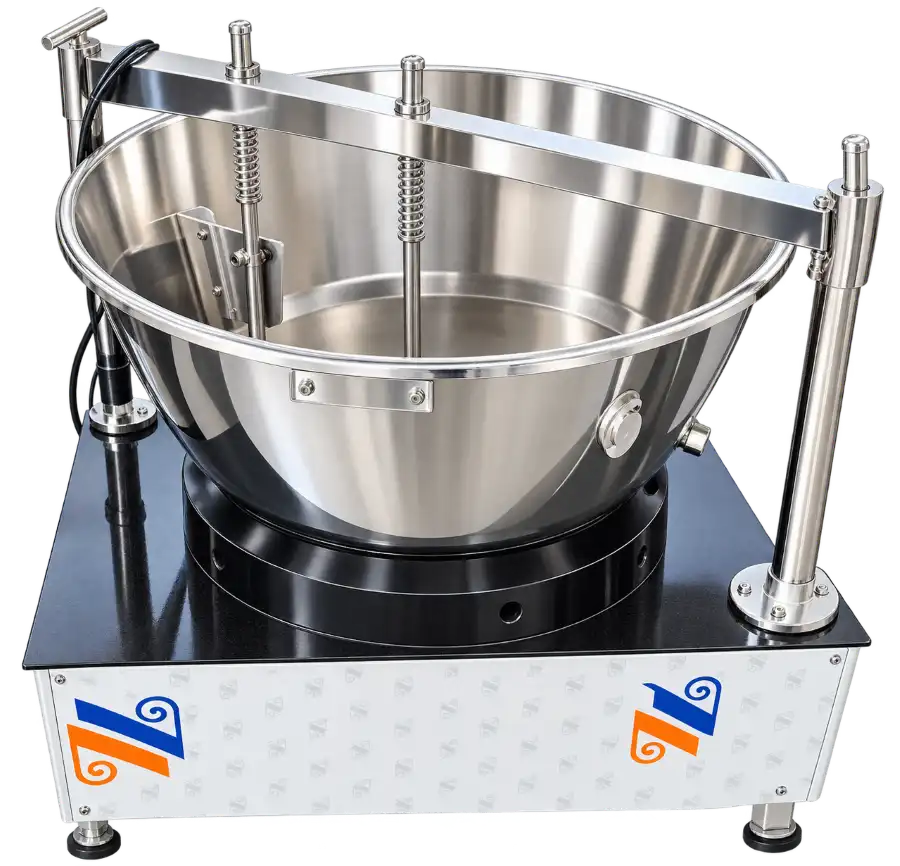
What Is a Khoya or Mawa Making Machine?
A khoya making machine, also called a mawa making machine or khoya machine, is dairy-processing equipment used to heat milk while stirring it as it thickens into khoya (mawa). Khoya is an important ingredient in many Indian sweets, and commercial producers need a repeatable way to process milk in batches.
Compared with a process that relies entirely on manual stirring, a motor-driven scraper system keeps moving over the pan surface while the milk is heated. The machine can reduce the amount of continuous manual stirring required. Results still depend on the milk, batch size, heating settings, operator procedure and recipe.
How Does an Automatic Khoya Making Machine Work?
The published KTPL machine description explains that milk is heated from below using a gas-fired system or a configured induction/steam heating arrangement. A motor-driven shaft rotates the scrapers through the milk. Spring-loaded scraper arms maintain pressure against the pan so the blades continue scraping as the milk reduces.
This movement is designed to help reduce milk sticking to the heated surface and lower the risk of scorching when the machine is used correctly. It also supports a more consistent workflow than stirring a full batch by hand. Follow the supplied operating instructions and do not leave a heated machine unattended.
KTPL Khoya Machine: Key Specifications
The following details are listed on the official KTPL Automatic Khoya / Mawa Making Machine product page. Confirm the exact model and configuration in writing before ordering.
Batch capacity: 50 to 300 litres per batch, depending on machine size. Pan material: food-grade stainless steel (SS 304). Scraper/stirrer motor: 0.5 HP to 1.5 HP gear motor. Motor supply: 220–240V single-phase or 380V three-phase, according to configuration. Operation: automatic or semi-automatic options. Scrapers: spring-loaded, using Teflon or food-grade scraper material as specified for the configuration.
The product page lists LPG/PNG gas heating and says induction/steam options may be configured. Heating arrangements, electrical supply, included accessories and automation level can vary, so ask KTPL to confirm the exact specification for the model being quoted.
How to Choose the Right Khoya Machine Capacity
KTPL lists sizes from 50 to 300 litres per batch. A suitable size depends on how much milk your business processes in each production run, how many batches you make in a shift and how much floor space and utility capacity are available. A larger pan is not automatically the best choice if your daily milk volume is small or your workflow cannot support it.
When requesting a quotation, share your expected milk quantity per batch, number of batches per day, available heating fuel, electrical supply and preferred level of automation. Ask the supplier to confirm the actual working capacity and recommended operating procedure for the specific model.
Benefits of a Commercial Mawa Making Machine
Less continuous manual stirring: the powered scraper performs the repeated scraping motion while an operator manages the process. Reduced sticking risk: spring-loaded scrapers are designed to keep contact with the pan surface and help limit milk sticking or scorching. Food-contact material: the listed pan is made from food-grade SS 304 stainless steel. Flexible production: the range of batch sizes can suit different commercial workflows. Multiple uses: the product page lists applications beyond khoya, including rabdi, kulfi base, basundi, ghee and halwa mixes.
These are design and workflow benefits, not a guarantee of a particular production yield or energy saving. Actual results depend on milk composition, recipe, heating source, batch size, machine settings and cleaning/maintenance practices.
What Can You Make With a Khoya Mawa Machine?
The KTPL product page lists sweet shops and sweets manufacturers, khoya/mawa production units, dairy plants and commercial kitchens as applications. It also lists rabdi, kulfi base, basundi, ghee and halwa mixes as possible uses, subject to the correct process and machine configuration.
If you intend to process products with different textures or recipes, confirm suitability with the supplier before purchase. Ask about batch changeover, cleaning between products, scraper materials and any special operating steps needed for your product range.
Heating Options, Power Supply and Installation Checks
Heating source is an important part of choosing a mawa making machine. The KTPL listing refers to an LPG/PNG gas burner and also mentions induction or steam configurations. Do not assume that every heating option is standard on every model; confirm which heating system is included in your quotation.
The listed scraper-motor supply is 220–240V single phase or 380V three phase, depending on configuration. Before installation, ask for the machine’s final electrical load, phase requirement, heating utility requirements, footprint, installation clearances, ventilation and safety instructions. Have utilities checked by a qualified installer.
Khoya Making Machine Price: What Affects the Cost?
The khoya making machine price depends on the selected batch capacity, automatic or semi-automatic operation, heating method, motor configuration, scraper arrangement, material and fabrication details, accessories, delivery and service terms. Quotes from different suppliers may describe different machine configurations, so compare like for like rather than comparing only the headline price.
KTPL’s product page asks buyers to use the enquiry option for the latest price and availability; it does not provide a fixed public price for every configuration. For a current mawa making machine price, request a written quotation through the KTPL khoya machine product page or the KTPL quotation enquiry page. Confirm taxes, delivery, installation, heating setup, warranty, included accessories and service support before placing an order.
Buying Checklist: Questions to Ask Before Ordering
1. Capacity: what is the recommended working batch size for your milk volume? 2. Material: confirm SS 304 for the product-contact pan and ask for the final material specification. 3. Scrapers: confirm the scraper material and spring-loaded arrangement. 4. Heating: verify whether gas, induction or steam is supplied and what utilities are needed.
5. Automation: clarify which operations are automatic and which require an operator. 6. Power: confirm phase, voltage and motor details. 7. Hygiene and maintenance: obtain cleaning instructions and guidance on replacing scraper parts. 8. Commercial terms: get the full quotation, delivery timeline, warranty, installation scope and after-sales support in writing.
Cleaning and Routine Maintenance
Follow the cleaning procedure and food-contact guidance supplied with the exact machine. Switch off and isolate the appropriate power or heating source before cleaning, and allow hot equipment to cool according to the manufacturer’s instructions. Use cleaning products and methods compatible with the stainless steel pan and scraper material.
Inspect scrapers, springs, shaft connections and the drive assembly at the recommended intervals. Replace worn or damaged parts with compatible components and do not operate the machine if a safety-critical component is loose or damaged. Correct cleaning and maintenance support hygienic production and reliable operation.
Request a Quote for KTPL’s Automatic Khoya / Mawa Machine
To check availability and select a suitable configuration, visit the KTPL Automatic Khoya / Mawa Making Machine page. Share your batch size, daily milk volume, heating preference, power supply and whether you need automatic or semi-automatic operation. This helps the supplier respond with a configuration-specific price instead of an unclear generic estimate.
For other dairy equipment and purchasing support, use the KTPL milk and dairy equipment catalogue or submit an enquiry through Get a Quote.